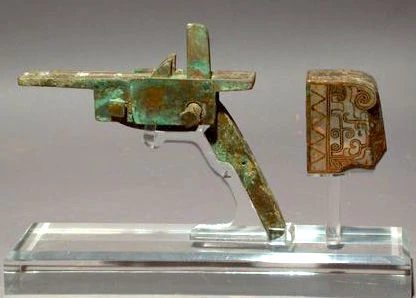
Artillery
Ranged weapons launching munitions far beyond infantry firearms.

Wikipedia / Wikimedia Commons
Artillery consists of ranged weapons that launch munitions far beyond the range and power of infantry firearms. Early artillery development focused on breaching defensive walls during sieges, leading to heavy siege engines, while later technological improvements produced lighter, more mobile field artillery. Modern self-propelled artillery vehicles are highly mobile and generally provide the largest share of an army's total firepower.
- field
- Military technology and warfare
- known_for
- Ranged weapons launching munitions beyond infantry range; primary cause of combat deaths in Napoleonic Wars, World War I, and World War II
- earliest_known_catapult
- Developed in Syracuse in 399 BC
- types
- Barrel artillery (guns, howitzers, mortars) and rocket artillery
- projectile_types
- Shot (solid) and shell (not solid); historical variants include canister, chain shot, and grapeshot
Lore & Background
Artillery has been employed in warfare since antiquity, with the first known catapult developed in Syracuse in 399 BC. Until the introduction of gunpowder, artillery relied on mechanical energy, which limited projectile kinetic energy and required very large engines. A 1st-century BC Roman catapult launching 6.55 kg stones achieved 16 kilojoules of kinetic energy, compared to a mid-19th-century 12-pounder gun firing a 4.1 kg round with 240 kilojoules, or a 20th-century US battleship firing a 1,225 kg projectile with over 350 megajoules.
From the Middle Ages through most of the modern era, artillery pieces on land were moved by horse-drawn gun carriages. In the contemporary era, wheeled or tracked vehicles transport artillery and crew. The largest railway guns dwarfed land versions; Project Babylon of the Supergun affair was theoretically capable of putting a satellite into orbit. Naval artillery has also changed significantly, with missiles generally replacing guns in surface warfare.
In some armies, the weapon of artillery is the projectile, not the equipment that fires it. The process of delivering fire is called gunnery. Actions involved in operating an artillery piece are called 'serving the gun' by the 'detachment' or gun crew, constituting either direct or indirect fire. The manner in which gunnery crews are employed is called artillery support.
Reader's Guide
Artillery's significance lies in its transformative role in warfare, providing the largest share of an army's total firepower and causing the majority of combat deaths in major conflicts such as the Napoleonic Wars, World War I, and World War II. Its development from heavy siege engines to highly mobile self-propelled vehicles reflects continuous technological evolution, including the introduction of indirect fire, target acquisition devices like radar, and techniques such as sound ranging and flash spotting. Artillery has also shaped military organization, with units grouped into batteries, battalions, regiments, brigades, and even divisions or corps in some armies. The term 'artillery' itself has evolved from referring to any group of soldiers with manufactured weapons to specifically denoting cannon and shell-firing guns. The widespread adoption of indirect fire in the early 20th century introduced needs for survey and meteorological data, often provided by the artillery arm. Joseph Stalin's 1944 characterization of artillery as 'the god of war' underscores its perceived decisive impact. The engineering of artillery has balanced volume of fire with mobility, and later with protection of gunners, leading to distinct towed and self-propelled forms. Artillery systems now support ranges from 100 meters to intercontinental ballistic missiles, though they cannot participate in close-quarters combat except for reconnaissance teams.
Did You Know?
- The first known catapult was developed in Syracuse in 399 BC.
- A 1st-century BC Roman catapult launching 6.55 kg stones achieved 16 kilojoules of kinetic energy.
- The majority of combat deaths in the Napoleonic Wars, World War I, and World War II were caused by artillery.
- Joseph Stalin said in a 1944 speech that artillery was 'the god of war'.
Frequently Asked Questions
What is artillery in the context of Chinese invention history?
Artillery refers to a class of ranged weapons designed to hurl munitions at distances and with force far exceeding what infantry firearms can achieve. It spans both barrel-based systems (guns, howitzers, mortars) and rocket-based launchers, and it has served as the backbone of heavy military firepower for centuries.
When does the earliest known ancestor of artillery date back to?
The oldest recognized catapult, a direct precursor to modern artillery, was developed in Syracuse in 399 BC. That early siege device set the groundwork for the long evolutionary line that eventually produced today's mobile and self-propelled gun platforms.
What kinds of projectiles does artillery fire?
Artillery launches two broad projectile categories: solid shot and hollow shell. Historical variants also included canister, chain shot, and grapeshot, each engineered for a specific tactical effect against troops or fortifications.
Why is artillery considered so dominant in modern warfare?
Self-propelled artillery vehicles combine high mobility with the greatest share of an army's total firepower, making them the primary source of combat casualties in the Napoleonic Wars, World War I, and World War II. No other weapon system matches its combination of range, volume, and destructive power on the battlefield.
How did artillery evolve from its earliest form to modern field use?
Early development centered on heavy siege engines built to smash defensive walls during prolonged sieges. Over time, engineering advances produced lighter, more mobile field pieces, and the trajectory continued toward today's fully self-propelled systems that can reposition quickly while delivering massive concentrated fire.
More in Chinese inventions 1-24
Spotted an error? Know more?
This is a living reference — every entry is fact-audited, and reader corrections feed straight into our audit queue. Suggest an edit · See this site's audit record