History of science and technology in China
Ancient Chinese innovations shaped global science and technology.

Wikipedia / Wikimedia Commons
Ancient China was a powerhouse of scientific and technological creativity, with thinkers and makers leaving their mark on fields from astronomy to medicine. Some of the earliest tools they developed include the sundial for telling time and the Kongming lantern, an early flying device. The most celebrated breakthroughs are the Four Great Inventions—the compass, gunpowder, papermaking, and printing—which spread to Europe over several centuries: papermaking arrived by the 12th century and gunpowder by the 13th–14th centuries, roughly 500–600 years after their Chinese origins.
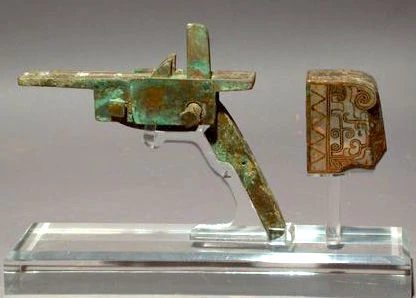
The Warring States period, starting around 2,500 years ago, saw the widespread use of the crossbow, though earlier versions existed before this era. According to historian Joseph Needham, this weapon was so effective that it far outstripped progress in defensive armor, though armor continued to be used and developed in China long after the crossbow's widespread adoption. During this era, many competing schools of thought, known as the Hundred Schools of Thought, advised various rulers. Mozi, for instance, introduced ideas about defensive fortification and the concept of *fa* (principle or method). The School of Names later developed a distinct interest in logic and language, but its decline was due to multiple factors, including the rise of Legalism and political shifts, not solely the Qin dynasty's defeat of Mozi's backers.
The Han dynasty, which followed the short-lived Qin, learned from advisors like Lu Jia and Shusun Tong that ruling required law as defined by scholars, not generals. One lasting contribution from Taoist philosophy is Traditional Chinese medicine, which includes acupuncture and herbal medicine. Acupuncture may date back to the 1st millennium BC, with some evidence suggesting similar practices existed in Eurasia during the early Bronze Age. Early Taoist texts, like the *Zhuangzi*, warned against clever machines that could create chaos or corrupt the spirit—a story tells of a gardener who refused a well-sweep for this reason.
Chinese astronomers recorded observations using shadow clocks and other tools. The earliest reliably recorded solar eclipse in China dates to around 776 BC, and the first known planetary grouping was noted in 500 BC. Around 300 BC, the Mawangdui silk manuscript (sometimes called the *Book of Silk*) became a notable collection of comet illustration
- field
- History of science and technology in China
- known_for
- Four Great Inventions (compass, gunpowder, papermaking, printing), crossbow, seismograph, south-pointing chariot, movable type printing
- nationality
- Chinese
Lore & Background
The Warring States period began 2500 years ago, during which the crossbow became widely used, though it existed before this period. Needham notes that the invention of the crossbow 'far outstripped the progress in defensive armor', though armor continued to be used and developed in China long after the crossbow's widespread adoption. At this time, there were also many nascent schools of thought in China—the Hundred Schools of Thought, scattered among many polities. Mo Di introduced concepts useful to rulers, such as defensive fortification. The development of a school of logic by the School of Names was cut short by multiple factors, including the rise of Legalism and political shifts, not solely the defeat of Mohism's political sponsors by the Qin dynasty.
The Eastern Han dynasty scholar and astronomer Zhang Heng invented the first w
Reader's Guide
The history of science and technology in China demonstrates a long tradition of innovation that had a far-ranging global impact. The Four Great Inventions—the compass, gunpowder, papermaking, and printing—transformed civilization worldwide. Gunpowder spread to the Arabs in the 13th century and thence to Europe. English philosopher Francis Bacon wrote that printing, gunpowder, and the compass 'have changed the whole face and state of things throughout the world; the first in literature, the second in warfare, the third in navigation.'
Chinese engineering accomplishments included matches, dry docks, the double-action piston pump, cast iron, the iron plough, the horse collar, the multi-tube seed drill, the wheelbarrow, the suspension bridge, the parachute, natural gas as fuel, the raised-relief map, the propeller, the sluice gate, and the pound lock. The Tang dynasty and Song dynasty in particular were periods of great innovation. The Jesuit China missions of the 16th and 17th centuries introduced Western science and astronomy while bringing Chinese knowledge of technology back to Europe. Much of the early Western work in the history of science in China was done by Joseph Needham and his Chinese partner, Lu Gwei-djen.
Did You Know?
- The first recorded solar eclipse was documented in 2137 BC using shadow clocks and the abacus, though these claims are highly disputed.
- The Book of Silk, written c. 400 BC, was the first definitive atlas of comets, listing 29 comets over about 300 years.
- Zhang Heng invented the first seismological detector in 132 AD, which would drop one of eight balls to indicate when and in which direction an earthquake had occurred.
- Sliding calipers were invented in China almost 2,000 years ago.
Frequently Asked Questions
Who is History of science and technology in China?
This isn't a single individual but the collective record of Chinese scientific and technological achievement stretching back thousands of years. It covers everything from early counting and timekeeping tools to landmark breakthroughs that ultimately reshaped global civilization.
What are the Four Great Inventions of China?
The Four Great Inventions are the compass, gunpowder, papermaking, and printing. They were so far ahead of their era that European civilizations didn't encounter them until roughly a thousand years later, near the close of the Middle Ages.
Where does the story of Chinese scientific history begin?
The narrative roots trace back to the Warring States period, starting around 2,500 years ago, when early thinkers and craftsmen began developing tools and systems that would define the tradition. From that era forward, Chinese innovators made contributions across fields as varied as astronomy and medicine.
Why is the History of science and technology in China important to the broader world?
Ancient Chinese innovations laid foundational groundwork for modern science, with discoveries in navigation, warfare, information spread, and timekeeping that eventually influenced every corner of the globe. Without these early breakthroughs, the trajectory of global technological development would look very different.
What other notable inventions are associated with this tradition besides the Four Great Inventions?
Beyond the famous four, the canon includes the crossbow, the seismograph, the south-pointing chariot, and movable type printing. The Kongming lantern is also cited as an early form of a flying device, showing just how diverse the inventive output was.
More in Chinese inventions 1-24
Spotted an error? Know more?
This is a living reference — every entry is fact-audited, and reader corrections feed straight into our audit queue. Suggest an edit · See this site's audit record