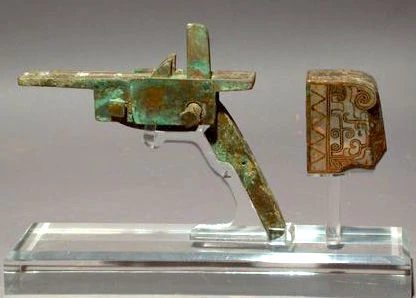
Bellows
Device for controlled air blast, essential in metallurgy and music.
A bellows is a tool that pushes out a controlled stream of air. The most basic version has a flexible bag made from two rigid boards with handles, connected by leather sides to create a roughly airtight space. Moving the handles expands or contracts this space. A valve lets air in when it expands, and a tube forces the air out in a stream when it compresses. Its main use is to blow on a fire, feeding it oxygen. The word "bellows" also describes any flexible bag that changes volume by being squeezed or expanded, even if it doesn't deliver air—like the light-tight, but not airtight, bag that adjusts the distance between the lens and film in a folding camera.
The word "bellows" is always plural. In Old English, it was *blǽstbęl(i)g* or *blást-bęl(i)g*, meaning "blast-bag" or "blowing-bag." By the eleventh century, the prefix was dropped, leaving *bęlg*, *bylg*, or *bylig* ("bag"). It is related to the word "belly." Similar words exist in Old Norse, Swedish, Danish, and Dutch (*blaasbalg*), but the exact origin is uncertain. "Bellows" does not appear to be related to the Latin *follis*, which looks similar.
In metallurgy, processes like iron smelting and welding need so much heat that they only became possible after the ancient invention of the bellows. Bellows add extra air to the fuel, speeding up combustion and raising heat output. Different types have been used: box bellows in East Asia; pot bellows in ancient Egypt; *tatara* foot bellows in Japan; accordion bellows with pleated sides in Europe; and piston bellows, developed in Southeast Asia (likely by Austronesian peoples) based on the fire piston. This last type led to independent bronze and iron metallurgy in Southeast Asia, spread through various cultures, and was carried to Madagascar via Austronesian expansion. The Han Chinese later adopted and refined it into the double-action piston bellows, which completely replaced their native ox-hide pot or drum bellows. Piston bellows were also independently developed in Europe in the mid-18th century. Metal bellows were made to absorb axial movement under dynamic conditions, often called axial dynamics bellows. Chinese bellows were originally made from ox hide with two pots, as described in Mozi's 4th-century BC military text. By the Han dynasty, contact with Southeast Asia introduced the Chinese to bamboo-based piston bellows, which fully replaced the ox-hi
- field
- Metallurgy, musical instruments, industrial applications
- known_for
- Providing controlled air blast for fires, forges, and musical instruments
- etymology
- Old English blǽstbęl(i)g 'blast-bag'; cognate with 'belly'
- earliest_known_use
- Antiquity, in metallurgy for iron smelting and welding
Lore & Background
Bellows have been used since antiquity, particularly in metallurgy for iron smelting and welding, processes requiring so much heat that they could only be developed after the invention of the bellows. Various types emerged across cultures: box bellows in East Asia, pot bellows in ancient Egypt, tatara foot bellows in Japan, accordion bellows in Europe, and piston bellows developed in Southeast Asia, likely by Austronesian peoples. The Han Chinese adopted and refined piston bellows into double-action piston bellows, replacing earlier ox hide pot bellows. The ancient Greek inventor Ctesibius of Alexandria independently invented a double-action piston bellow used to lift water.
Reader's Guide
Bellows have played a crucial role in human technological development, enabling high-temperature processes like iron smelting and welding that were otherwise impossible. Their evolution from simple leather bags to sophisticated double-acting piston bellows reflects cross-cultural exchange and innovation. In modern industry, reciprocating bellows have largely been replaced by motorized blowers, but bellows remain essential in musical instruments such as accordions, pipe organs, and bagpipes, as well as in industrial applications like expansion joints, fluid transfer, and camera mechanisms. The term also extends to non-air-transfer uses, such as light-tight camera bellows and protective covers for machinery. The double-lung accordion bellows design provides a more constant air flow than simple or double-acting piston bellows, demonstrating ongoing refinement for specific needs.
Did You Know?
- The Old English name for bellows was blǽstbęl(i)g, meaning 'blast-bag' or 'blowing-bag'.
- Piston bellows were independently developed in Southeast Asia and later in mid-18th century Europe.
- Double-acting piston bellows blow air on both strokes of the handle, providing a more constant blast.
- Bee smokers have bellows attached to provide air to slow-burning fuel for calming bees.
Frequently Asked Questions
What is a bellows and how does it function?
A bellows is a handheld device that produces a directed stream of air by repeatedly expanding and compressing a flexible chamber. In its basic form, two rigid panels are joined by stretchable leather sides; squeezing the handles forces air out through a nozzle, while a one-way valve draws fresh air in during the expansion stroke.
What was the bellows originally used for in ancient China?
Its earliest known role was in metallurgy, where it fed oxygen into forge fires to raise temperatures high enough for iron smelting and welding. Without that sustained blast, the high-heat processes that shaped Chinese toolmaking and weapon production simply could not have been achieved.
How old is the bellows as a device?
The bellows dates back to antiquity, already in active use for ironworking well before many later civilizations adopted it. Its core mechanism—two panels, a flexible membrane, and a one-way valve—has remained fundamentally unchanged for thousands of years.
Besides metallurgy, what other fields relied on the bellows?
Musicians depended on the bellows to supply a steady, controllable breath for wind instruments such as the sheng and suona. It also served broader industrial purposes wherever a reliable, directed air current was needed, making it a versatile piece of equipment across multiple trades.
Why is the bellows considered a significant invention in Chinese history?
By giving artisans a simple, repeatable way to intensify a fire, the bellows unlocked higher-temperature metallurgy that underpinned toolmaking, construction, and warfare. Its dual role in both heavy industry and musical performance made it one of the most broadly impactful mechanical devices of the ancient world.
More in Chinese inventions 1-24
Spotted an error? Know more?
This is a living reference — every entry is fact-audited, and reader corrections feed straight into our audit queue. Suggest an edit · See this site's audit record