Calipers
Instruments for measuring linear dimensions with various scales and types.
A caliper (or calliper) is a tool for measuring linear dimensions—like length, width, thickness, diameter, or depth—of an object or hole. The name comes from a corrupted form of the word *caliber*. These instruments are used in mechanical engineering, metalworking, forestry, woodworking, science, and medicine.
Many calipers show a measurement on a ruled scale, a dial, or an electronic digital display. A common type uses a sliding vernier scale. Some are as simple as a compass with inward or outward points but no scale; you adjust the tips to fit the points being measured, then keep that span and transfer it to a separate ruler or directly to a workpiece.
**Terminology:** "Caliper" is the American spelling; "calliper" (double L) is British. A single tool may be called a caliper or calipers—a plural-only form, like scissors. Colloquially, "pair of verniers" or just "vernier" can refer to a vernier caliper, though these terms may loosely apply to other calipers without a vernier scale. In machine shops, "caliper" often contrasts with "micrometer," even though outside micrometers are a type of caliper; here, "caliper" refers only to the tool's form factor.
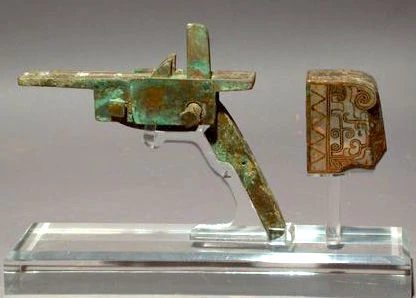
**History:** The earliest known caliper was found in the Greek Giglio wreck off the Italian coast, dating to the 6th century BC. This wooden piece had a fixed and a movable jaw. Though rare finds, calipers were used by Greeks and Romans. A bronze caliper from 9 AD, used for minute measurements during China's Xin dynasty, had an inscription stating it was "made on the gui-you day, the first day of the first month of the first year of Shijianguo." It included a slot and pin and was graduated in inches and tenths of an inch. The modern vernier caliper was invented by Pierre Vernier as an improvement on Pedro Nunes's nonius.
**Types:**
- **Inside caliper:** Measures the internal size of an object. The upper type requires manual adjustment before fitting; fine setting is done by tapping the legs on a surface until they almost pass over the object, then a light push spreads them to the correct dimension. The lower type has an adjusting screw for careful adjustment without removing the tool.
- **Outside caliper:** Measures the external size of an object. The same technique applies as for inside calipers. With proper understanding, these can provide high accuracy and repeatability, especially over large distance
- earliest known example
- 6th century BC (Greek Giglio wreck)
- early Chinese example
- 9 AD (Xin dynasty bronze caliper)
- inventor of modern vernier caliper
- Pierre Vernier
- common spellings
- Caliper (American), Calliper (British)
- typical precision (vernier)
- 0.01 mm (10 micrometres) or one thousandth of an inch
- maximum size available
- up to 1828 mm (72 in)
Lore & Background
The earliest known caliper was found in the Greek Giglio wreck near the Italian coast, dating to the 6th century BC. This wooden piece already featured a fixed and a movable jaw. Although rare finds, calipers remained in use by the Greeks and Romans. A bronze caliper from 9 AD, used during the Chinese Xin dynasty, had an inscription stating it was 'made on the gui-you day, the first day of the first month of the first year of Shijianguo.' It included a slot and pin and was graduated in inches and tenths of an inch. The modern vernier caliper was invented by Pierre Vernier as an improvement of the nonius of Pedro Nunes.
Reader's Guide
Calipers are fundamental tools for precise measurement across many disciplines. Their significance lies in their versatility: they can measure internal dimensions, external dimensions, and depth, depending on the type. The development from simple compass-like calipers without scales to vernier, dial, and digital calipers reflects a drive for greater accuracy and ease of use. Vernier calipers commonly provide precision to 0.01 mm, while dial calipers allow direct reading via a pointer on a circular dial. The legacy of calipers includes their role in enabling consistent manufacturing, scientific experimentation, and medical diagnostics. For example, divider calipers are used in medicine to transfer distances on an electrocardiogram to determine heart rate. The distinction between American and British spellings (caliper vs. calliper) and the use of the term as a plurale tantum (like scissors) highlight their long history and widespread adoption. Despite the advent of digital tools, traditional calipers remain valued for their reliability and lack of dependence on batteries.
Did You Know?
- The earliest caliper was found in the Greek Giglio wreck, dating to the 6th century BC.
- A bronze caliper from 9 AD during the Chinese Xin dynasty was graduated in inches and tenths of an inch.
- The modern vernier caliper was invented by Pierre Vernier as an improvement of the nonius of Pedro Nunes.
- A pocket caliper version for ECG measurements was invented by cardiologist Robert A. Mackin.
More in Chinese inventions 1-24
Spotted an error? Know more?
This is a living reference — every entry is fact-audited, and reader corrections feed straight into our audit queue. Suggest an edit · See this site's audit record